endorsements
This short book threads together beautifully its author’s passion for South Devon, his enchantment with fruits and love for Palestine. It provides a unique introduction to Palestine and its people. Intertwining so profoundly one’s love for pastoral south Devon with one’s commitment for Palestine is something I intimately experienced myself when I was forced out of my university in Israel and moved to Dartington in 2007, where I met the author and many other excellent people fully committed and engaged in the solidarity movement with Palestine. Even if your library is full of books on Palestine, it would be amiss to be without this extraordinary and original book.
Ilan Pappe | Professor, University of Exeter, author of The Ethnic Cleansing Of Palestine
An amazingly original book that narrates the history of Palestine in an accessible, creative, and deeply cultural way—most importantly through the indigenous fruits of Falastin. It weaves simple prose that conveys hard, brutal truths with beautiful, often sad poetic lines that at the same time reflect the sumud of Palestinians and their thousands-year-old indigenous fruit trees, deeply rooted in Bilad al-Sham (the Levant). Ian Wellens’ book lays it bare: simply put, it is a history that everyone in the global Palestine solidarity movement must have.
Tahrir Hamdi | professor, Arab Open University in Jordan, author Imagining Palestine
Ian Wellens has produced a gem of a book on Palestine's history. It presents in marvellously analytical, summary form all the salient points of the Palestine-Israel conflict. Highly recommended.
Ghada Karmi | Physician, academic, author of In Search Of Fatima, Return and Murjana
Despite the wealth of excellent books on Palestine that have been published in recent years, there have been few that attempt to explain the “situation”, or that great misnomer “conflict” — what is actually happening, and how we got here — in a way that can be understood, and indeed embraced, by the general public. Yet it is hard to imagine a more urgent task.
Ian Wellens’ A History of Palestine in Five Fruits answers this call brilliantly. Straight-forward, yet elegant and imaginative, he takes the reader through the last century-and-a-half of this land between the river and the sea, explaining with simple clarity what happened and why, step-by-step. The writing’s often understated tone is an asset in gaining the trust of a public that must weigh its credibility against the lies in which our entire society is drowning. A highly recommended antidote for anyone who believes that Palestine is complicated.
Thomas Suárez | historian, musician, author of Palestine Hijacked and Palestine Mapped
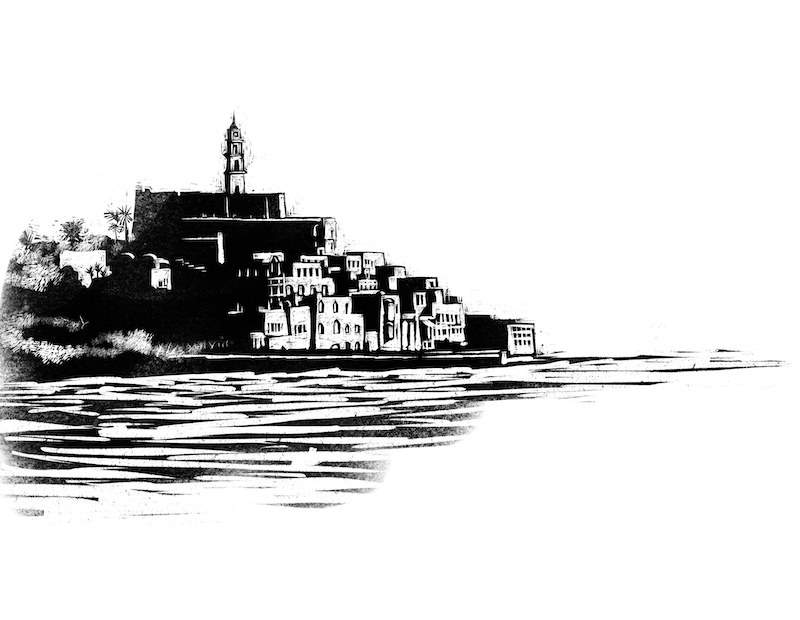
The olive trees Zionist settlers tear down; the city of Jaffa which Jewish fighters stole - and the oranges with it - for Israel to market; the watermelon, symbol of Palestine that Zionists tried to ban: through these and other fruits of the Palestinian land Ian Wellens finds evidence of the sumud - the steadfast resistance - that will one day return the land to its rightful people.
Tim Llewellyn | former BBC Middle East Correspondent
An awe-inspiring piece of writing … I was immensely moved by it, quite overwhelmed. This book is for everyone who has ever stared in horror at reports of genocide in Gaza and wondered how such a situation came about. The author presents the history of Palestine in a clear and accessible chronology of events; a story of injustice and tragedy written with eloquence and passion. And woven into the narrative, there is poetry. The story of five fruits, grown in this land for centuries, and the importance of their harvest, both symbolic and real, to the people of Palestine and their unfolding tragedy. A History of Palestine in Five Fruits left me speechless, tearful… and enlightened.
Stephanie Austin | author
Five Fruits is a compelling and rewarding read for anyone seeking to understand the background to the horrors of Gaza.
Andy Rowell | investigative journalist, researcher, author of A Quiet Word
Ian Wellens’ A History of Palestine in Five Fruits is a compassionate account that masterfully bridges microhistory with a people’s history, reclaiming the lived experience of Palestine by starting with the soil itself—the very essence of Palestinian resistance and sumud. Wellens’ unique approach interprets Palestine through symbols and markers deeply resonant with the Palestinian collective experience, challenging the often dehumanized nature of purely political or ideological narratives.
Narrating history through the prism of food is a methodology akin to the way Palestinians have historically positioned their relationship to the land and their liberation struggle. This is history written from the ground up—a project of tangible memory and cultural reclamation that is, in many ways, unparalleled. Highly recommended.
Ramzy Baroud | Historian, Editor of The Palestine Chronicle, author of Before The Flood, The Last Earth and These Chains Will Be Broken.
This story of Palestinian opposition and resistance, containing a powerful message for world leaders … the living history of a long struggle, which points out that there could have been a very different path – there could have been equality instead of apartheid. It is a history from which we all can learn.
Garth Hewitt | songwriter, founder The Amos Trust
This is a remarkable book, a brief and approachable history of Palestine told in a way that is simple, but never banal, never dumbed down. Idiosyncratic, even quirky, it is also poetic - and none the worse for that.
Graham Bash | Political Officer, Jewish Voice for Liberation
I looooove this book … I read it in one sitting … essential reading for anyone interested in the ongoing genocide and savagery in Gaza and the occupied territories … poetic, but utterly readable and understandable.
Brigid Keenan | founder, Palestine Literature Festival
The ignorance surrounding the Palestinian conflict remains staggering, even amidst the relentless 24/7 news cycle. While scholars and politicians have long struggled to map this minefield, an unexpected voice has joined the fray: Ian Wellens, a humble cheesemaker from Devon.
Why would a man rooted in the quiet pastures of South West England throw his hat into such an incendiary arena? He does so by pivoting away from the dry rhetoric of borders and serving the conflict straight onto the plate. His book, A History of Palestine in Five Fruits, recognises that in this region, food is rarely a "unifier." Instead, it is a deeply charged battleground for identity and legitimacy. In a conflict defined by erasure, a piece of fruit is not just sustenance; it is a tangible archive of lost heritage.
Wellens manages to tiptoe through the heavy symbolism of the land—moving past ancient olive groves that represent rootedness and the orange orchards of Jaffa that evoke a lost golden age—before concluding with the watermelon. Today, the watermelon is perhaps the most defiant fruit in history; with its red flesh, black seeds, and green rind, it has become a "proxy flag" for a people whose actual banner was once banned from their own streets.
As a child, Wellens was brought up on Jaffa oranges; it was a name common to all the fruit he peeled and ate. I marvelled at this observation because I, too, was familiar with the "Jaffa," yet had never given a second thought to the 19th-century trade that reached from these orchards to Berlin, Paris, and London. It was through these oranges, Wellens observes, that Palestine was first known to the world.
There is a profound sadness in his writing as he recalls a film from 2009 showing a time when Palestinians and Jews worked together in the orange trade, supporting one another’s businesses. This cooperation was eventually snuffed out by the arrival of hardline settlers and the introduction of a "Hebrew-only" labour market. Wellens notes poignantly:
"It is a reminder that things in Palestine didn't have to turn out as they did... there was a seed (or perhaps a pip) which could have grown into a different future: one in which Palestine was not a 'Jewish State' but rather a state for all, in which all lived together—as equals.”
If only that pip had been nurtured and tended. Instead, many Palestinian labourers eventually found themselves picking fruit for their new Jewish bosses in the very orchards they once owned.
Wellens’ book is peppered with such stories and injustices. By the time he settles on the newly empowered watermelon, he has explained the conflict in simple, human terms. The book contains many surprises, even for those who think they know everything there is to know about the region so I'm not going to do any spoilers.
However, I would thoroughly recommend it as a gentle yet firm introduction to one of the world’s bloodiest and most unjust conflicts—one that will surely come to define the 21st century.
Dr Yvonne Ridley | Journalist, author and Middle East analyst.